

Scientists have uncovered evidence suggesting that enormous octopus-like creatures once roamed Earth’s ancient oceans, potentially reaching lengths of up to 19 metres.
The research challenges long-held assumptions about prehistoric marine life, indicating that these soft-bodied creatures could grow far larger than previously believed. Fossilised traces and feeding patterns found in ancient rock formations point towards the existence of a powerful predator unlike modern octopuses.
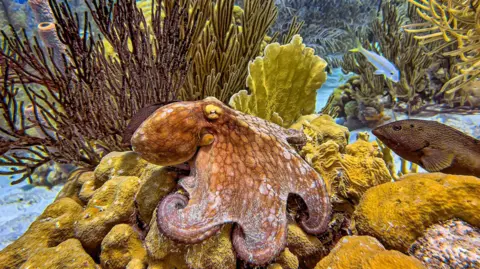
According to the study, these giant creatures likely used their tentacles to capture prey, leaving behind distinctive marks on shells and other marine fossils. These markings have helped researchers reconstruct how the animals may have behaved and hunted.
Unlike creatures with hard skeletons, octopuses rarely leave behind complete fossils. This makes the discovery particularly significant, as scientists have had to rely on indirect evidence such as bite patterns and environmental clues to estimate their size and presence.
Researchers suggest that the ancient oceans may have supported conditions suitable for such large soft-bodied animals, including abundant prey and fewer competing predators. The findings hint at a more complex and diverse marine ecosystem than previously understood.
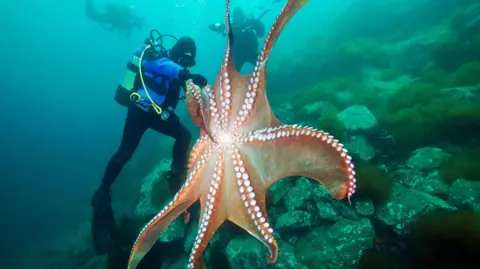
Modern octopuses are known for their intelligence, flexibility, and hunting ability, and scientists believe their ancient relatives may have shared similar traits—just on a much larger scale.
The study opens new questions about how these massive creatures lived, evolved, and eventually disappeared, offering a fascinating glimpse into a largely hidden chapter of Earth’s prehistoric life.


